
Build morning rituals by choosing one intention for the day, attaching it to something you already do, and naming the next action that expresses it. Before opening your messages or leaving home, decide how you want to respond to a real situation; journaling, meditation, and jewelry are optional, not requirements.
- Morning rituals work as personal practices, not guarantees: choose one intention and give it a practical next step.
- Start with an existing habit, such as getting dressed, rather than adding an elaborate routine.
- EclipticJew crystal jewelry is an optional symbolic reminder; no stone is necessary for intention-setting.
- Keep personal rituals distinct from Taoist, Buddhist, and chakra traditions.
Why this matters
Your phone is waiting, someone needs an answer, and the day already has a direction. A morning ritual gives you a place to choose your response before you enter those demands. It does not need to make you feel peaceful to be useful.
An intention describes how you want to act; a task describes what you will do. Pair them rather than asking an uplifting phrase to carry the whole day. For more on that distinction, explore turning visualization into a next action.
For your 2026 routine, start with an ordinary morning rather than an imagined perfect one. Build around the responsibilities you actually have, including early shifts, children, shared spaces, or an unpredictable schedule.
How do you build morning rituals around one personal intention?
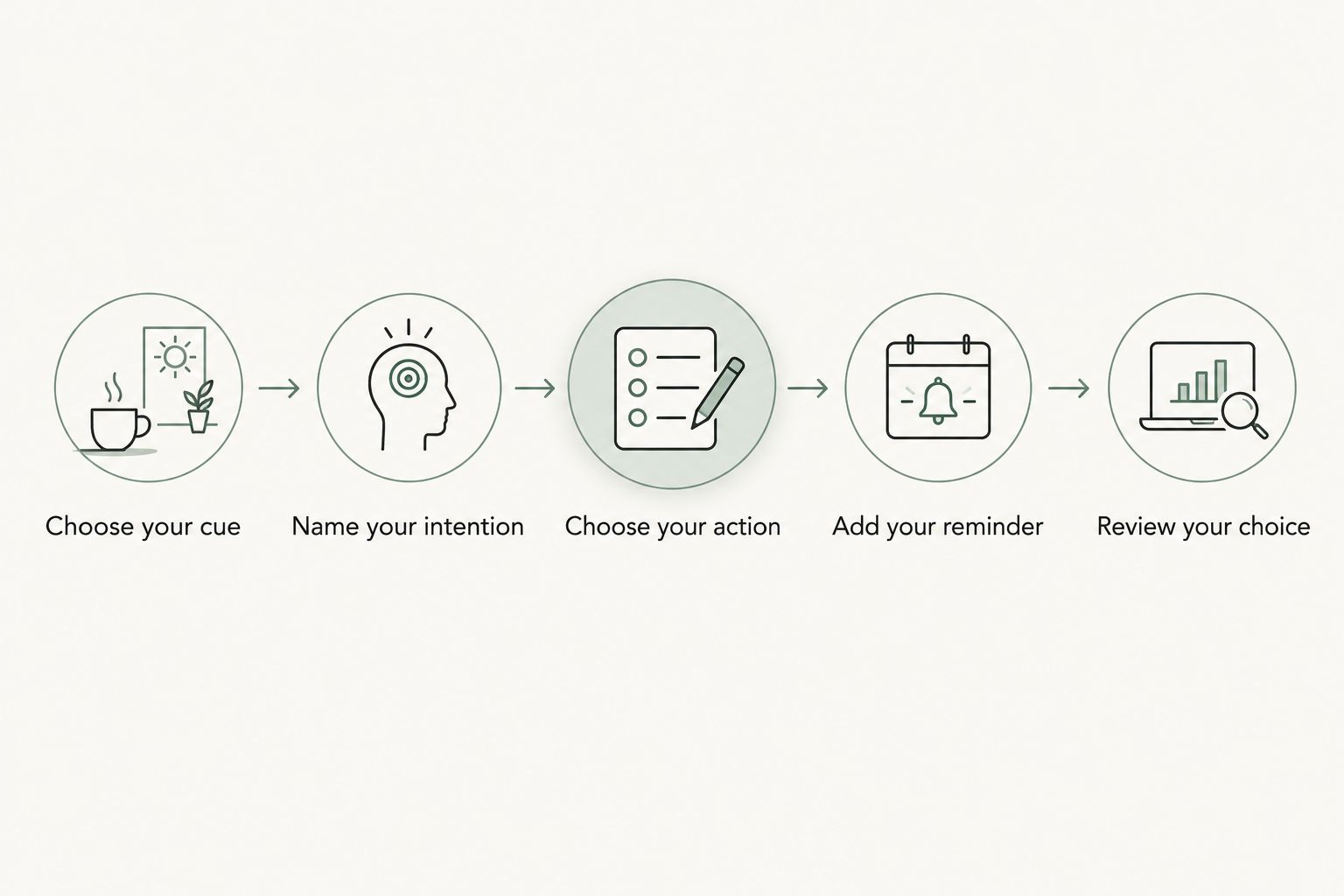
Use the following sequence as a starting template, not a test. You can do it standing beside your wardrobe, sitting at the kitchen table, or preparing to start work. No special room or object is needed.
1. Choose your cue
Attach the ritual to something that already happens: getting dressed, placing your keys in your bag, or sitting down before work. Choose a cue that belongs to your morning as it is.
Make the connection specific. Instead of deciding to reflect sometime before breakfast, decide to name your intention after putting on your shoes. If breakfast is unpredictable, do not make breakfast the foundation of the practice.
2. Name your intention
Choose a quality you can express through behavior. Patience, honesty, steadiness, curiosity, and care all leave room for a concrete choice. You do not have to feel that quality before acting on it.
For example, patience can mean letting a colleague finish speaking before you respond. Confidence can mean asking the question you prepared, even if your voice feels uncertain. Avoid intentions that depend on controlling someone else's response.
3. Choose your action
Finish this sentence: Today, I will express this intention by doing ______.
Keep the action within your control. Preparing a meeting note is within your control; ensuring everyone respects you is not. Sending a thoughtful message is an action; making someone feel closer to you is an outcome you cannot promise.
Choose something small enough to recognize when it happens. An intention becomes easier to assess when you can point to a decision, a sentence, or a completed task.
4. Add your reminder
Write the intention where you will encounter it, or connect it to an object you already use. A notebook, a familiar doorway, or a bracelet can serve as the reminder. The object is not responsible for the action.
For a suggested starting limit, spend 1 minute choosing your words rather than searching for a perfect phrase. This is a practical boundary for the exercise, not a measured requirement or a promise of results.
5. Review your choice
At the next natural pause, ask whether the intention still fits the day. You can revise it when circumstances change. Choosing patience before an ordinary meeting does not prevent you from choosing firmness when a boundary becomes necessary.
Later, allow 2 minutes to identify a specific moment when you acted on the intention. If nothing comes to mind, describe what got in the way without turning the review into a judgment about your character.
The sequence stays the same whether your 2026 mornings begin at home or before a shift: choose a cue, name an intention, identify an action, add a reminder, and review the choice.
Which morning ritual fits your actual day?
Choose a format according to the space and attention you want to give it. These are alternatives, not steps you must stack together. Start with the least elaborate option that lets you name an intention and act on it.
| Format | Best for | What you do | Advantage | Limitation |
|---|---|---|---|---|
| Spoken intention | A rushed or shared morning | Say your intention quietly and name the next action | Requires no supplies | Leaves no written record |
| Written intention | Sorting through competing priorities | Write the intention and its matching action | Gives you something specific to revisit | Can become another unfinished journaling task |
| Quiet pause | A transition before starting work | Sit or stand comfortably, then choose your response to the day | Does not require speaking or writing | Silence alone does not identify the action |
| Object reminder | People who enjoy a tactile cue | Connect an existing object with the chosen action | Carries personal meaning into an ordinary moment | The object can become a distraction or feel unnecessary |
If writing makes the ritual feel like homework, use spoken words. If an object invites more shopping than reflection, leave the object out. None of these formats is more spiritually valid than another.
For a 2026 routine you can revise, choose your format provisionally. Keep what serves the intention and remove what adds obligation without meaning.
What should your personal intention actually say?
A useful intention addresses a situation you expect to face. It does not need to predict the day or describe an ideal version of yourself. Use plain words you would say in conversation.
Before a difficult conversation
Choose honesty with care. Your matching action might be writing down the point you need to make before the conversation starts. Decide what you are asking for, not just what you dislike.
The limitation matters: careful preparation does not control the other person's reaction. Your intention concerns the way you speak and listen, not a guarantee that the discussion ends comfortably.
When your attention feels scattered
Choose deliberate attention. Name the task you intend to open first, and put unrelated tasks somewhere you can return to later. Avoid making the intention a demand to feel mentally clear all day.
A practical version is to open the document you need before opening optional messages. That is an observable choice. It does not require you to claim that a ritual or stone improves cognitive function.
When you need a boundary
Choose respectful firmness. Prepare the sentence you will use if someone asks for time or work you cannot give. You can be considerate without leaving your answer unclear.
An intention of protection can remain personal symbolism, but the practical protection in this example is the boundary itself. Jewelry does not enforce it for you.
When you want more connection
Choose curiosity. Prepare a sincere question for someone you care about, then give their answer your attention. Connection is not something you can secure by performing the correct ritual.
If you are dating, the same distinction applies. You can choose openness and respectful communication without treating another person's interest as proof that your intention succeeded.
Why morning rituals vary
Morning rituals differ because people have different responsibilities, preferences, and relationships with symbolism. Use these factors to decide what belongs in yours:
- Your schedule: Choose a cue that fits your actual start, including shift work or caregiving.
- Your available space: A spoken intention can suit a shared room better than an uninterrupted seated practice.
- Your day's demands: A difficult conversation calls for a different action than a day spent organizing paperwork.
- Your preferred reminder: Written words, familiar objects, and spoken phrases offer different ways to revisit the intention.
- Your relationship with tradition: A personal routine does not require religious language; an established spiritual practice deserves its own context.
- Your comfort with jewelry: Leave a bracelet out when it interferes with work, fit, or daily care.
A routine that suited an earlier season of life does not need to define your 2026 mornings. Change the format when your circumstances change, while keeping the action clear.
How long should morning rituals take?
1 minute is a suggested starting boundary for naming an intention, not an evidence-based minimum. If you want more space, add a brief written reflection or a quiet pause. Longer is not automatically more meaningful.
For a rushed morning, try 30 seconds to name the quality and its next action. These durations are optional exercise prompts, not performance targets. Do not interrupt necessary care, medication instructions, or responsibilities to complete them.
Do you have to do the same morning ritual every day?
One intention is enough to give the practice a clear focus, but it does not have to be the same intention every day. Keep the cue familiar if that suits you, and let the words respond to the situation in front of you.
Repeating patience when you need to speak firmly is not consistency worth protecting. Review whether the intention helps you make a useful choice, not whether you have preserved an unbroken streak.
Where an optional bracelet fits
An existing bracelet can mark the moment you choose an intention while getting dressed. Touching or noticing it later can become your personal prompt to recall the action. No particular stone is required, and you can use no object at all.
EclipticJew crystal jewelry is best for shoppers who want a wearable symbol of personal intention, not a promised outcome. If you are considering an object reminder, the tiger's eye, clear quartz and prehnite beaded bracelet is an optional example to review. Check the listing for its materials, sizing, construction, and care before choosing it.
The advantage is personal: you might enjoy carrying a visible, tactile reminder. The limitation is equally clear. A bracelet cannot perform the action, change another person's choices, or guarantee calm, income, protection, or spiritual results.
Do not add a blessing requirement to a secular routine. Optional Taoist blessings are associated with select pieces only; check the individual listing rather than assuming the service or a blessing video applies to every item.
If you already practice within a religious tradition, keep its meaning intact. Taoist blessings, Buddhist prayer beads, and chakra practices are not interchangeable names for a generic morning exercise. Follow the context of the practice rather than combining traditions simply to make a routine feel complete.
Keep the reminder practical
Choose an object you are comfortable using, not something you feel obliged to carry. If a bracelet distracts you at a keyboard, catches during a task, or does not suit your workplace rules, leave it off. The intention remains available without it.
Put bracelets on after your washing and grooming routine, and follow the care guidance for the individual materials. Remove bracelets at night; do not sleep in elastic-cord jewelry to keep an intention active. Personal meaning does not require continuous wear.
For your 2026 practice, treat comfort and care as part of the decision. A useful reminder belongs in your life without demanding that you ignore the object’s physical limits.
FAQ
What's the simplest way to start morning rituals?
Choose one intention, connect it to an existing morning habit, and name a practical action. You do not need a journal, jewelry, or a dedicated space.
Can I do a morning ritual without meditation?
Yes, a morning ritual can be a spoken intention or a brief written note. Meditation is optional, not a requirement for choosing how you want to act.
What if I miss my morning ritual?
Resume at the next suitable pause rather than treating the day as lost. An intention can guide a later choice without a completed morning routine.
Do crystals make morning intentions come true?
Crystals do not guarantee that intentions come true. You can use a stone as personal symbolism while relying on practical actions for the choices within your control.
Do I need EclipticJew crystal jewelry for intention-setting?
No, EclipticJew crystal jewelry is optional for intention-setting. A written note, an existing object, or no object at all can fit the same personal practice.
Can I keep the same personal intention all week?
Yes, you can repeat an intention if it still fits your circumstances. Choose a relevant action each day rather than repeating words that no longer match what you need.
Does a morning ritual need a spiritual blessing?
No, a personal morning ritual does not require a spiritual blessing. If a blessing matters to your practice, understand its tradition and verify any service on the individual product listing.
One last thing
Prepare a shortened version of your ritual before you need it. On an interrupted morning, simply name the intention and the next action while getting dressed. You have permission to leave the notebook closed and the bracelet in its place.
If you want a wearable reminder, choose a stone whose appearance and meaning you genuinely enjoy, then measure your wrist before considering EclipticJew. The next action matters more than finding the perfect object.


