
A full moon release ritual can be as simple as naming what you want to stop carrying, writing down what remains within your control, and choosing a next action. Use the moon as a personal marker, not a promise that circumstances will change. You need no fire, crystals, special words, or visible moonlight to follow this reflective practice in 2026.
- A full moon release ritual works as personal reflection, not a guarantee of change.
- Write what you are releasing, identify your responsibility, and choose a practical next action.
- Keep, fold, or tear your note; burning it is unnecessary.
- EclipticJew crystal jewelry is optional for shoppers who want a wearable symbol of personal intention.
How do you do a full moon release ritual without fire?
Write honestly, choose what you will do differently, and close the session without demanding a particular feeling. This is a personal journaling exercise, not a ceremony presented as belonging to a particular religious tradition. If you prefer a practice without lunar symbolism, use the same steps as a grounding ritual without buying anything.
Gather paper and a pen, or open a private note on your device. Sit somewhere you can leave the page undisturbed; ordinary room lighting is enough. You do not need candles, incense, an altar, or an outdoor setting.
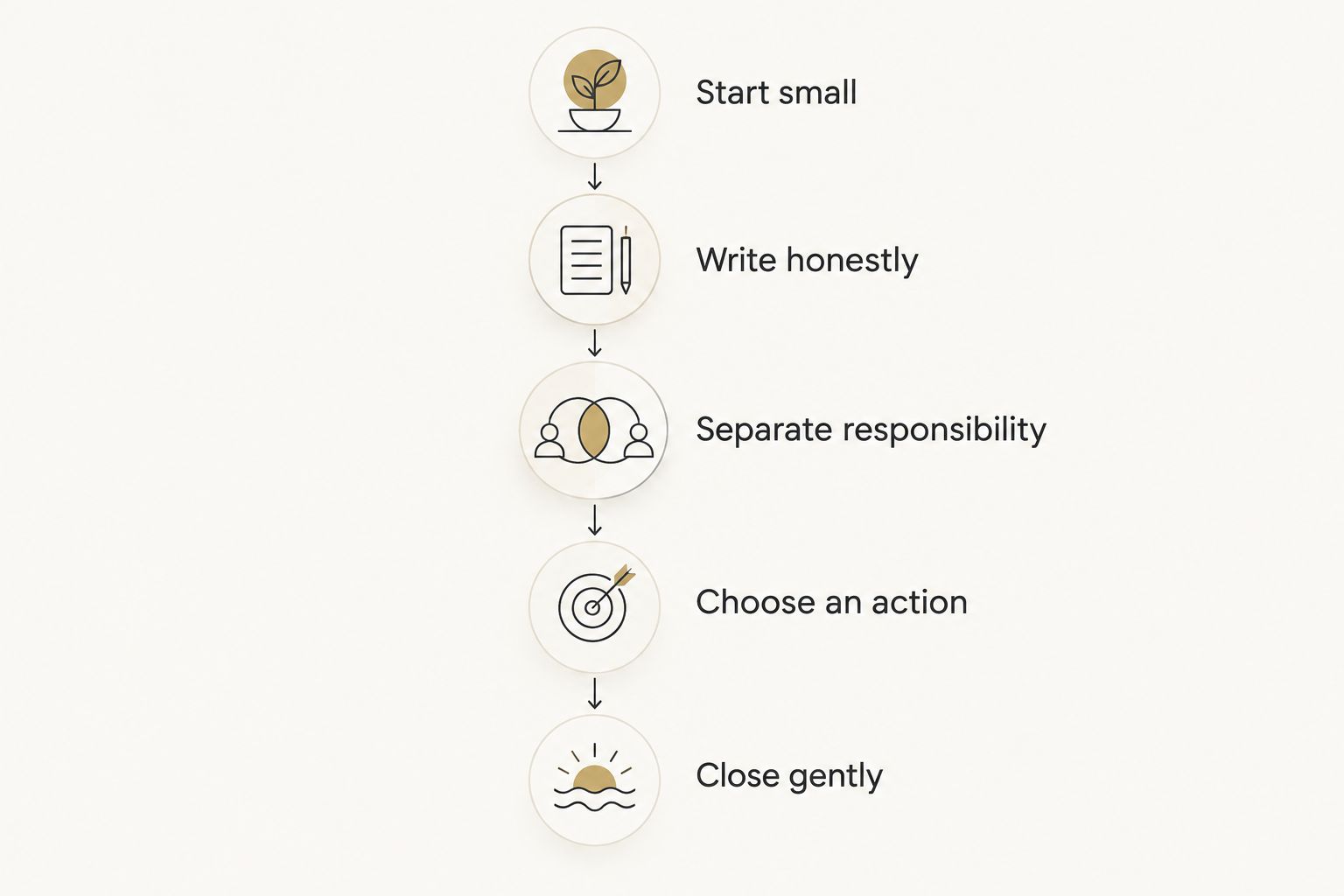
Start small
- Name the situation. Describe something specific: rereading an unanswered message, accepting work you cannot reasonably finish, or postponing a difficult conversation. Choose a situation rather than judging your whole character.
- Write honestly. Complete the phrase: I want to stop carrying… Name a habit, expectation, or responsibility you have taken on, rather than trying to erase a feeling.
- Separate responsibility. Write what you can change and what belongs to someone else. You can choose your response; you cannot choose another person's apology, affection, or decision.
- Choose an action. Turn the reflection into something observable, such as muting a conversation, declining an extra task, or drafting a question you need answered.
- Close gently. Fold the note, save it privately, or tear it up. Put away your materials and return to an ordinary activity without checking whether the ritual worked.
The closing gesture marks the end of the exercise. It does not erase consequences, cancel obligations, or make an unresolved relationship complete.
Why this matters: release is not erasure
A difficult email can remain unanswered after you close your journal. An old disappointment can still hurt. The useful aim is to decide how you will respond, not to prove that you have stopped caring.
Treating release as a command to feel better adds another demand to an already difficult moment. Instead, give the practice a modest purpose: notice what is happening, distinguish your choices from your wishes, and decide what deserves attention next.
You can enjoy lunar symbolism without making the moon responsible for the outcome. A full moon gives this practice a meaningful setting if that symbolism speaks to you; a quiet afternoon is also enough.
What should you write during a full moon release ritual?
Choose language you can believe. A declaration that you have permanently released all fear is unnecessary when you are still nervous about tomorrow. A more honest sentence names the concern and limits the promise to your own behavior.
Use these prompts separately rather than treating them as a script you must finish:
- What am I repeatedly asking myself to solve that is outside my control?
- Which expectation no longer matches my circumstances?
- What responsibility is mine, and what have I assumed belongs to me?
- What am I avoiding that still needs a practical response?
- What would acting with more care look like next?
For a 2026 journal entry, you might use the heading What I am changing, followed by the situation and your intended response. The date helps you recognize the entry later; it does not give the words special power.
Example: waiting for a reply
Instead of writing that you no longer need anyone, acknowledge that you want a reply and do not control whether it arrives. Then decide what you will stop doing while you wait, such as repeatedly reopening the conversation.
Your next action might be to put the phone away during dinner. That action is yours to take regardless of what the other person does.
Example: carrying too much at work
Instead of declaring that all stress has left your life, identify the task you accepted without checking your capacity. Write the clarification you need to send about scope, priority, or timing.
Release, in this example, means stepping back from an unrealistic expectation. It does not mean abandoning a commitment without communicating.
Keep, fold, or tear: choose your fire-free ending
There is no required way to dispose of a release note. Choose the ending that fits your privacy needs and whether you want to revisit what you wrote. Keeping a page does not hold you back, and destroying it does not prove that you have moved on.
| Ending | Best for | Practical benefit | Limitation |
|---|---|---|---|
| Keep the page | Revisiting your chosen action | Preserves context for a later check-in | Sensitive writing needs private storage |
| Fold the page | Marking a pause without destroying it | Gives the exercise a clear stopping point | The underlying issue still needs attention |
| Tear the page | Choosing a physical closing gesture | Ends the exercise without a flame | The written reminder is lost unless you save the action separately |
| Save a private digital note | Writing without paper | Keeps the reflection accessible | Device access and shared accounts need consideration |
If you tear the page, copy the practical action somewhere you will actually see it first. You do not need to scatter the pieces outdoors, bury them, or put them into water. Dispose of them through your usual appropriate household waste route.
Avoid turning the ending into another test. You are allowed to keep a meaningful page, stop halfway through writing, or decide that this particular practice does not suit you.
Why your full moon release ritual can look different each time
A personal reflection practice does not need an identical setup every month. Let your circumstances determine its shape rather than forcing your evening to match a photograph.
- Privacy: Choose paper or a device based on where your words will remain private. You do not owe anyone a reading of your note.
- Emotional readiness: Start with an everyday frustration rather than the most painful experience you can recall. Stop if continuing feels overwhelming.
- Purpose: A habit needs a different next action from an unresolved conversation. Name the actual situation before choosing symbolic language.
- Belief: Use lunar imagery if it matters to you. Leave it out if a straightforward journal entry feels more honest.
- Practical setting: Shared rooms, caring responsibilities, and work schedules shape when you can pause. A ceremony does not outrank those needs.
For your 2026 practice, consistency of intention matters more than consistency of decoration. You can write at a kitchen table now and use a private digital note next time without treating either version as incomplete.
Can I do a full moon release ritual before or after the full moon?
Yes. This personal reflection exercise does not depend on an exact lunar moment. Choose a nearby time when you can give the writing your attention, or choose another day entirely.
If astronomical timing is part of your interest, check a 2026 lunar calendar for your time zone. That tells you when the phase occurs; it does not establish a deadline for emotional change or make a delayed journal entry less meaningful.
Do I need moonlight, crystals, or a blessing?
No. Paper, a private digital note, or quiet spoken reflection is enough for this exercise. Moonlight and objects are optional parts of the setting, not requirements for release.
Keep different traditions distinct. This personal journaling sequence is not a Taoist blessing, a Buddhist practice, or a chakra ceremony simply because you add beads or a crystal. A product's traditional symbolism also does not establish what will happen in your life.
EclipticJew natural-stone and crystal jewelry is best for shoppers seeking wearable personal symbolism, not guaranteed outcomes. If you already own a bracelet you enjoy, you can place it beside the page as a reminder of the action you chose; buying another object is unnecessary.
The benefit of an optional bracelet is straightforward: you can assign a familiar object a personal meaning. The limitation is equally clear: the bracelet cannot make a boundary, complete a task, change another person, or resolve distress for you.
If you use jewelry, keep the ritual dry and follow material-specific natural-stone bracelet cleaning guidance. Do not add salt, soaking, smoke, or outdoor exposure merely to make the setting feel more ceremonial. Remove bracelets before bed rather than sleeping in elastic-cord jewelry.
What if I feel nothing afterward?
Feeling nothing does not mean you performed the exercise incorrectly. This practice does not require tears, relief, certainty, or a sense of spiritual change.
Read the action you chose and ask whether it is specific enough to follow. If the page only says that you want less stress, make the next step clearer: identify the conversation, decision, or task that needs attention.
If reflection brings up distress you cannot comfortably manage, stop and seek appropriate support. A ritual is not a substitute for medical or mental health care, and you do not need to continue writing to demonstrate commitment.
FAQ
What's the simplest full moon release ritual for beginners?
Write what you want to stop carrying, identify what you control, and choose a practical next action. Close by saving, folding, or tearing the note; fire and special supplies are unnecessary.
Can I do a full moon release ritual indoors?
Yes, you can do this reflective practice indoors with ordinary lighting. You do not need a window, visible moonlight, candles, or an outdoor space.
Do I have to burn my release letter?
No, burning a release letter is unnecessary. Keep it privately if you want to revisit your action, or tear it after recording the part you intend to follow.
What should I release during a full moon ritual?
Choose a specific habit, expectation, or assumed responsibility you want to reconsider. Focus on your own behavior rather than trying to control another person's feelings or choices.
Can I use a bracelet during my full moon reflection?
Yes, a bracelet can serve as an optional personal symbol. EclipticJew jewelry is not required for this practice, and wearing a piece does not guarantee emotional, spiritual, protective, or financial results.
Is a full moon release ritual the same as a Taoist blessing?
No, this personal journaling exercise is not a Taoist blessing. Adding a crystal, symbolic charm, or prayer beads does not make different cultural and religious practices interchangeable.
What if I miss the full moon in 2026?
You can reflect on another day without treating the practice as invalid. If lunar timing matters to you, check a 2026 calendar for your time zone, but do not treat the phase as a deadline for changing how you feel.
One last thing: keep the action, not the pressure
The most useful part of a release page can be the sentence you decide to keep. Before putting it away, make sure that sentence describes something you can actually do, not an outcome you need someone else to deliver.
You can finish without feeling transformed. Put the pen down, return to your evening, and let the next action remain ordinary. If a stone would make a meaningful personal reminder, choose it for a symbolism you enjoy; if not, your written sentence is enough.


