

Yes, a gemstone bracelet can cause a skin reaction through contact with metal components, cord ingredients, surface treatments, trapped soap or sweat, or repeated rubbing. Remove the bracelet if your skin becomes itchy, sore, swollen, or blistered; the gemstone’s name alone cannot identify the cause.
- Can a gemstone bracelet cause a skin reaction? Yes—check metal, cord, finishes, friction, and trapped moisture.
- Remove irritating jewelry rather than wearing it longer to test your skin.
- EclipticJew gemstone bracelets are optional symbolic jewelry, not treatments for irritated skin.
- For your 2026 jewelry checklist, prioritize disclosed materials and comfortable fit over hypoallergenic-sounding descriptions.
Can a gemstone bracelet cause a skin reaction?
Yes. A bracelet brings several materials into contact with your wrist, and a reaction does not prove that you are allergic to the stone. A metal spacer, a cord additive, or soap held beneath the beads deserves attention too.
Check the whole construction before deciding what to replace. For routine maintenance after resolving the skin issue, use the natural-stone bracelet cleaning guide; cleaning jewelry is not a substitute for assessing a rash.
| Component or exposure | What to investigate | Useful distinction |
|---|---|---|
| Metal spacers, charms, clasps | Exact metal composition, plating, and nickel information | Nickel is a recognized cause of allergic contact dermatitis |
| Elastic or other cord | Cord material and any disclosed rubber ingredients | Stretchy cord does not automatically mean natural latex |
| Bead finishes and treatments | Dyes, coatings, resins, adhesives, or added oils | Natural stone does not mean every surface is untreated |
| Bead edges and fit | Rough spots, chips, pressure, and repeated movement | Mechanical irritation is different from an allergy |
| Moisture and residue | Sweat, soap, sanitizer, lotion, and incomplete drying | Material trapped beneath jewelry can irritate skin |
This table is a checking guide, not a diagnosis. Similar-looking rashes have different causes, and a clinician can distinguish contact dermatitis from other skin conditions.
Why this matters
A bracelet can feel comfortable when you put it on and become irritating during handwashing, exercise, or a long day at a desk. Your wrist moves repeatedly, while beads and cord hold close to the skin.
Do not treat discomfort as something you need to get used to. Removing the bracelet protects the irritated area from further contact and gives you a clearer starting point for investigating the cause.
Spiritual meaning belongs in a separate conversation. An itchy wrist is not evidence that a crystal is releasing negative energy, rejecting you, or working more intensely.
What should you do when your wrist starts itching?
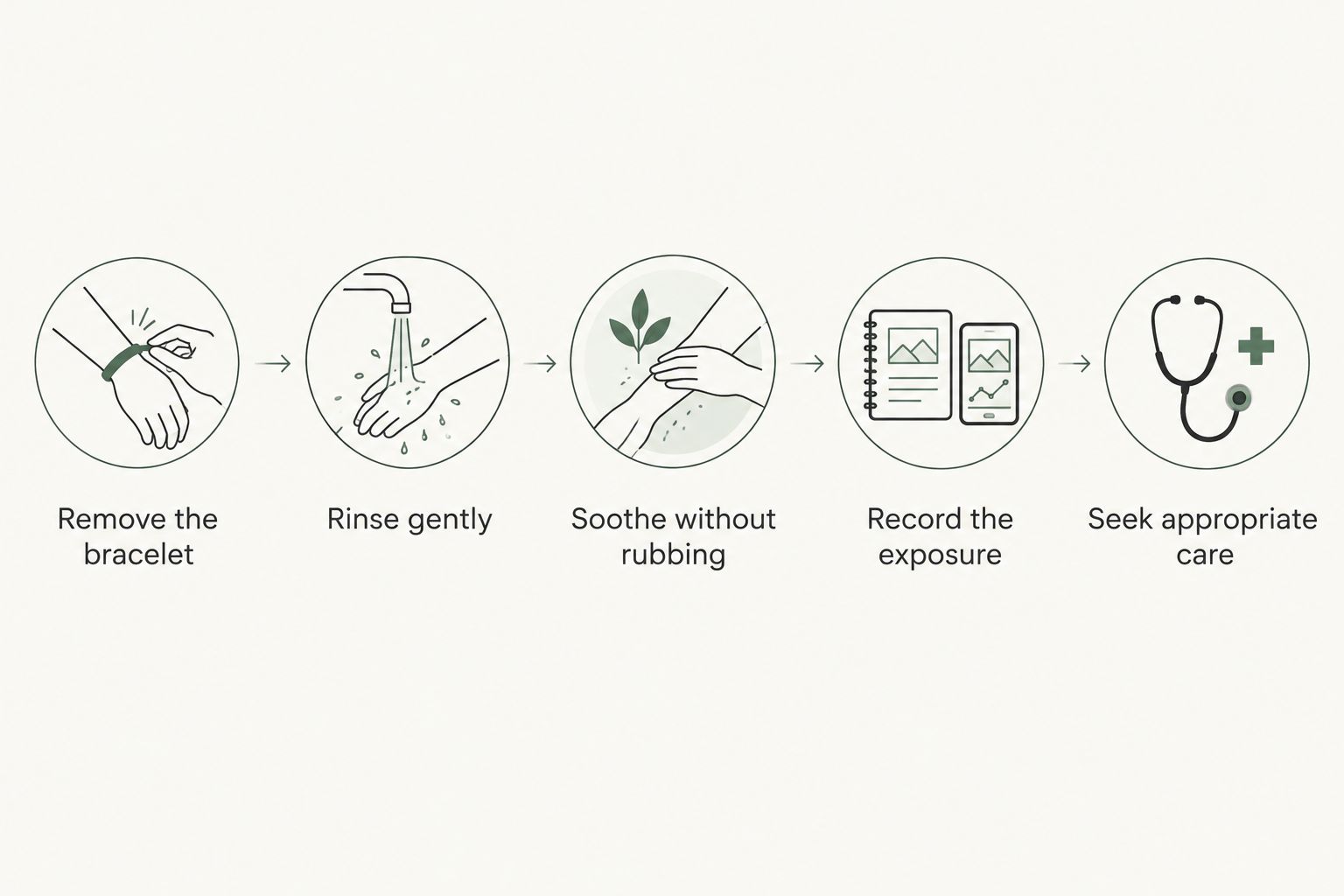
Start with your skin, not a replacement bracelet. These steps help limit further exposure without asking you to diagnose yourself.
- Remove the bracelet. Take off nearby jewelry too if it rubs the affected area. Do not move the suspect bracelet to the other wrist as an informal allergy test.
- Rinse gently. Use lukewarm water to remove surface residue, then pat dry. Avoid scrubbing, fragranced products, and attempts to disinfect the rash with alcohol.
- Soothe without rubbing. A cool, damp compress for 10–15 minutes can help relieve discomfort. Do not apply ice directly to your skin.
- Record the exposure. Photograph the rash and note where each bead, charm, knot, or clasp rested. Record recent changes in soap, lotion, cleaning products, and wearing habits.
- Seek appropriate care. Contact a clinician for a persistent, recurring, spreading, painful, or blistering rash. Do not keep wearing the bracelet while waiting for the skin to settle.
Trouble breathing, faintness, or swelling of the lips, tongue, or throat requires emergency help. Rapidly worsening swelling, fever, pus, or increasing warmth and pain also needs prompt medical assessment.
Keep the bracelet and its packaging available for reference. A clear photograph of the construction and any material description can help you explain the exposure without putting the jewelry back on.
Metal components: check more than the clasp
A bracelet described by its gemstone can still contain metal spacers, decorative caps, a charm, or a concealed connector. Inspect every part touching your wrist, including the underside of a focal ornament.
Nickel is a well-established contact allergen. Plating does not tell you the composition of the metal underneath, and a gold-colored or silver-colored finish does not establish what the component contains.
Ask the seller for the component’s actual material rather than relying on its color. If you have a diagnosed metal allergy, compare that information with your clinician’s advice before wearing the piece.
A metal-free design removes metal contact, but it does not eliminate every possible irritant. Cord, finishes, friction, and moisture still matter. That distinction is more useful than assuming one construction is safe for everyone.
Cord and elastic: ask what touches your wrist
Elastic-cord bracelets have no clasp to fasten, but the cord still contacts skin between beads and around the knot. Its ingredients are not always apparent from a product photograph.
Natural rubber latex can cause allergic reactions, and some rubber-processing chemicals cause delayed contact allergy. However, not all elastic jewelry cord contains natural latex. Do not diagnose a latex allergy simply because a bracelet stretches.
Ask whether the cord material is identified and whether latex information is available. If you already have a latex or rubber-accelerator allergy, unclear construction is a reason to pause rather than experiment.
Also inspect the knot area for a hard adhesive spot or frayed fibers. A localized scratch beneath a knot calls for a different investigation from a rash spreading around the entire wrist, although appearance alone cannot establish the cause.
Stone surfaces: natural does not mean reaction-proof
The word natural describes origin; it does not guarantee skin compatibility. A finished bead can also have a dye, coating, resin, wax, or other treatment that is not obvious from its appearance.
Surface treatments are not automatically harmful. The practical question is whether the materials are disclosed and whether you have a known sensitivity to them. A dyed bead is not proof of an allergy, just as an untreated bead is not a guarantee against irritation.
Look for chips, rough drill holes, and edges that catch against your skin. Stop wearing a damaged bracelet rather than sanding, heating, or chemically stripping the beads yourself.
A stone’s hardness rating describes scratch resistance, not allergy risk. Choosing a harder gemstone does not resolve an unknown reaction to a coating, cord, or metal component.
Why bracelet irritation varies
The same bracelet can contact your skin differently depending on fit, activity, and what remains beneath it. These factors explain why checking only the gemstone leaves important questions unanswered:
- Material sensitivity: Your personal allergy history matters more than a broad claim that a material suits sensitive skin.
- Fit and movement: Tight beads create pressure; excessive sliding creates repeated rubbing. Both deserve attention.
- Moisture: Sweat and water held beneath jewelry prolong damp contact and can contribute to irritation.
- Product residue: Soap, sanitizer, fragrance, and lotion can remain around beads or beneath a wide focal piece.
- Surface condition: Chipped beads, rough cord, worn plating, or a hardened adhesive spot change what touches your skin.
- Existing skin irritation: Eczema, scratches, and already-inflamed skin need care rather than another layer of jewelry.
Do not assume a reaction after exercise proves a sweat allergy, or that a rash beneath a charm proves a metal allergy. The pattern is useful information to bring to a clinician, not a diagnosis by itself.
Is bracelet irritation the same as a gemstone allergy?
Bracelet irritation is not automatically a gemstone allergy. Irritant contact dermatitis results from skin damage caused by an exposure, while allergic contact dermatitis involves an immune reaction to a particular substance.
Allergic contact dermatitis often develops 24–72 hours after contact, rather than immediately. Previous comfortable wear does not rule it out because sensitization can develop over time.
Timing alone cannot identify the cause. Hives, rubbing, contact dermatitis, and unrelated skin conditions need different assessment, especially when symptoms recur.
Can a bracelet rash appear after months of comfortable wear?
A bracelet rash can appear after months of comfortable wear. Changes in skin sensitivity, surface wear, fit, or products trapped under the bracelet can change the exposure.
Record what changed instead of assuming the gemstone suddenly became unsuitable. A new hand cream, more frequent washing, or damaged components gives your clinician useful context.
Should you test the bracelet on your other wrist?
Do not test a suspect bracelet on your other wrist while investigating a reaction. Re-exposure can trigger another rash and does not reliably identify which component caused it.
A dermatologist can use clinical patch testing to investigate delayed contact allergy when appropriate. Taping a bead to your skin at home is not an equivalent test.
A practical 2026 checklist before choosing another bracelet
Wait until the skin has recovered and follow any medical advice before considering jewelry again. You do not need to replace the bracelet immediately—or buy anything at all.
EclipticJew gemstone bracelets suit shoppers seeking personal symbolism, not a medical solution for sensitive skin. For any piece you consider, separate its meaning from the material information needed to judge whether it fits your requirements.
Ask these questions before ordering:
- Which components touch the skin, including spacers and the knot?
- What are the metal and cord materials?
- Are relevant coatings, adhesives, or treatments disclosed?
- Does the sizing information explain how to measure your wrist?
- Are the care instructions appropriate for all the materials in the piece?
For your 2026 comparison notes, record exact material answers rather than labels such as gentle or skin-friendly. Skip a purchase when a known allergy makes an undisclosed component important. No stone color or symbolic association fills that information gap.
Once you have a suitable bracelet, remove it before washing, showering, exercising, and sleeping. Let skin dry before putting jewelry on, and follow material-specific care instructions rather than soaking every bracelet the same way.
FAQ
Can a gemstone bracelet cause a skin reaction even if it is real?
Yes, a genuine gemstone bracelet can cause a skin reaction. Metal, cord ingredients, surface treatments, friction, and trapped residue all need checking; authenticity does not guarantee skin compatibility.
What is the best gemstone bracelet for sensitive skin in 2026?
There is no single best gemstone bracelet for every person with sensitive skin in 2026. Choose according to your known allergies, disclosed construction, surface condition, and fit—not a stone’s reputation.
Does a rash mean my crystal is releasing negative energy?
No, a rash is not evidence that a crystal is releasing negative energy. Remove the bracelet and assess material exposure and skin irritation rather than continuing to wear it for spiritual reasons.
How long after wearing a bracelet can an allergic rash appear?
Allergic contact dermatitis often appears 24–72 hours after exposure. Timing varies, and a clinician must assess the rash rather than relying on timing alone.
Can I clean the bracelet and put it straight back on?
Do not put the bracelet straight back on irritated skin after cleaning it. Cleaning can remove residue, but it does not remove an allergen built into a component or correct a rough surface.
Are EclipticJew bracelets guaranteed not to irritate skin?
No individual skin-compatibility guarantee is established for EclipticJew bracelets here. Check the specific listing and ask about materials relevant to your known sensitivities before choosing a piece.
When should I get medical help for a bracelet reaction?
Seek medical advice for a persistent, recurring, spreading, painful, or blistering rash. Breathing difficulty or swelling of the lips, tongue, or throat requires emergency help.
One last thing
The smallest component deserves as much attention as the largest stone. A spacer or knot can contact your skin all day while the gemstone receives all the scrutiny.
For your next 2026 jewelry choice, start with material information and a wrist measurement—not a promise of perfect compatibility. If you return to EclipticJew gemstone bracelets, choose a meaningful piece only when its construction and fit meet your needs. Leaving your wrist bare remains a valid choice.


