
A 108-bead mala supports a full counting round, a 27-bead strand completes the same 108 repetitions in 4 rounds, and a 21-bead strand provides a shorter counting cycle rather than a universal substitute for 108. Mala bead count meaning depends on the religious tradition and how you use the strand; decorative beads and a guru bead do not automatically belong in the practice count. Choose the count for your actual routine, not as a promise of stronger spiritual results.
- A 108-bead mala supports a full counting round; a 27-bead strand reaches 108 repetitions in 4 rounds.
- A 21-bead strand offers a shorter cycle, but its symbolism depends on the specific tradition.
- Mala bead count meaning concerns prayer beads and practice structure, not guaranteed spiritual effects.
- EclipticJew mala jewelry suits shoppers who want a wearable object for personal intention, not promised outcomes.
What does mala bead count mean for 108, 27 and 21 beads?
The count tells you how many repetitions a strand can track before you return to its starting point. Symbolism adds another layer, but that layer is not identical across Buddhist, Hindu and other religious settings. A bead count alone cannot identify a strand's lineage or explain every ornament attached to it.
For a 2026 purchase, separate three questions: how many counting beads the strand contains, what tradition its design references, and whether its construction suits your use. The mala beads sets guide is a useful next step when you want to compare formats rather than choose from the number alone.
| Strand | Counting structure | Best for | Advantage | Limitation |
|---|---|---|---|---|
| 108 counting beads | 108 repetitions in one round | A practice that specifies 108 repetitions | Tracks the target without recording multiple rounds | More strand to handle and store |
| 27 counting beads | 27 repetitions per round; 4 rounds equal 108 | Compact counting with a separate round tally | Shorter strand to carry | You must remember completed rounds |
| 21 counting beads | 21 repetitions per round | A deliberately short cycle or a practice specifying 21 | Gives a clear stopping point | Whole rounds do not total exactly 108 |
These are counting comparisons, not rankings of spiritual value. A short strand is not less sincere, and a long strand does not make a practice more effective by itself.
Why the count matters
Imagine sitting down before a difficult conversation and deciding to repeat a personal phrase. If you keep checking whether you have finished, counting becomes the task. Beads give your fingers a physical sequence to follow while you repeat the phrase.
That practical function is separate from religious meaning. You can use a strand as a secular tactile reminder without claiming that your routine belongs to a particular tradition. If you follow a religious practice, use that practice's instructions rather than replacing them with general shopping advice.
Choose a count that serves the practice you already intend to do. You do not need jewelry to begin: you can repeat a phrase, use a written tally, or sit quietly without counting at all.
108 beads: a full counting round
A 108-bead mala is a widely recognized format in Hindu and Buddhist practice. In some Buddhist explanations, 108 is associated with the defilements or afflictions addressed through practice. Interpretations differ, so that association should not become a universal explanation for every 108-bead strand.
The practical advantage is straightforward. With 108 counting beads, you can track 108 repetitions without separately remembering shorter rounds. A distinct guru bead, when present, commonly marks the beginning and end rather than adding another repetition.
Best for: following a practice that calls for 108 repetitions. The trade-off is handling a longer strand, particularly if you also want to wear it during ordinary activities. Check its measurements and intended wearing method instead of assuming every full mala works as a wrist wrap.
Choose 108 because it matches your counting needs or your tradition. Do not choose it because a listing suggests that more beads produce more protection, luck or healing. Those outcomes do not follow from the count.
27 beads: a quarter-length counting strand
A 27-bead strand gives you one quarter of 108 repetitions. Complete 4 rounds of 27 repetitions and the total is 108. That arithmetic makes the format useful when you want a shorter strand but still intend to reach the longer target.
The extra task is tracking rounds. You can record each finished round on paper or use another simple tally that does not interfere with moving through the beads. Without that separate record, the compact format leaves you remembering two things at once.
Best for: portable counting when you are comfortable tracking 4 rounds. Its advantage is a shorter strand; its limitation is the additional round tally. Neither feature makes it inherently better or worse than a full mala.
A 27-bead strand is not automatically a correctly fitted bracelet. Bead diameter, spaces, knots and the closure all affect its overall size. If you intend to wear it, compare the listed bracelet measurements with your wrist rather than treating the count as a sizing chart.
21 beads: a shorter cycle with context-dependent meaning
A 21-bead strand tracks 21 repetitions in a complete round. Its religious meaning depends on the specific practice, teacher or community associated with it. There is no single explanation that applies to every piece sold with this count.
Unlike 27, 21 does not divide evenly into 108. Completing 5 rounds produces 105 repetitions, leaving 3 repetitions to reach 108. If exact counting matters, account for that difference instead of assuming the formats are interchangeable.
Best for: a short personal routine or instructions that explicitly call for 21 repetitions. The clear stopping point is useful; the limitation is that complete rounds do not align with a 108-repetition target.
For a secular routine, you can decide that one round is enough. That is your chosen structure, not a claim that 21 carries a universally agreed spiritual power. If you want a traditional explanation, ask which tradition the seller is describing.
Why mala bead count meaning varies
The same number can appear in different kinds of jewelry. Meaning comes from more than the visible total, so use these distinctions when comparing descriptions:
- Religious context: Hindu, Buddhist and Taoist practices are not interchangeable. A shared bead format does not erase their differences.
- Practice instructions: A teacher or community can specify a particular repetition target or handling method.
- Counting convention: Guru beads, markers and decorative elements can be treated differently from the working beads.
- Design purpose: A wearable bracelet can prioritize fit, while a counting strand prioritizes a repeatable sequence.
- Personal use: A secular intention routine reflects the wearer's choice, not an inherited religious explanation.
For your 2026 comparison, ask the seller to distinguish the counting total from the total number of visible components. A photograph can show the design, but it does not always explain which parts belong in the count.
How do you count mala beads correctly?
Start by identifying the beads you will actually use for repetitions. Count those once before beginning, especially if the strand includes ornaments, separators or a larger terminal bead. Do not rely on the product name alone.
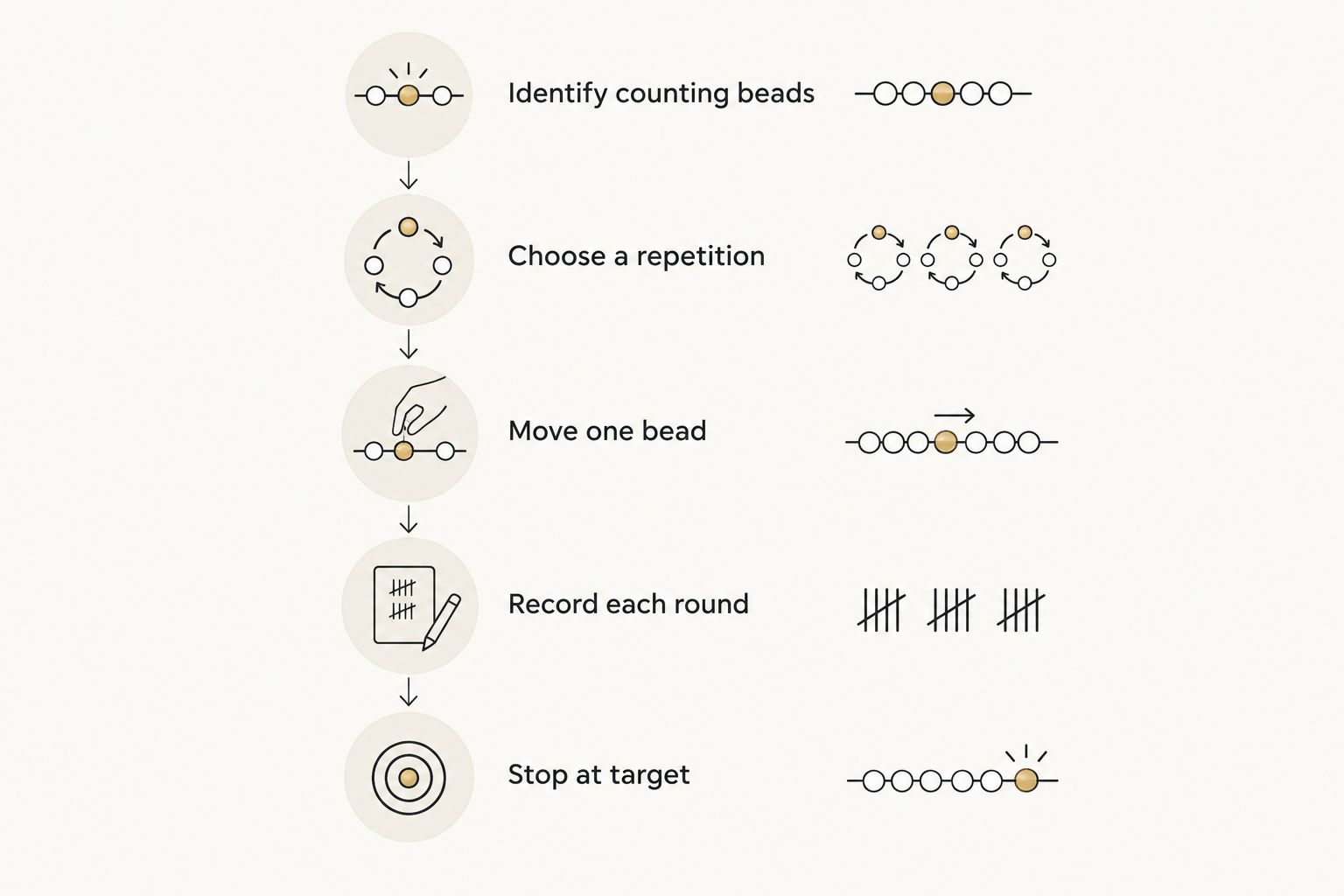
- Identify counting beads. Separate the working sequence from any markers or decorative components according to the listing or your practice instructions.
- Choose a repetition. Use the prayer or mantra taught within your tradition, or choose a personal phrase for a clearly secular routine.
- Move one bead. Advance one counting bead for each completed repetition, using a gentle grip.
- Record each round. Keep a separate tally when your target requires multiple passes through a shorter strand.
- Stop at target. Finish at the number you intended rather than treating a longer session as automatically better.
In some traditions, practitioners reverse direction at the guru bead rather than crossing over it. Follow your own tradition's guidance on that detail. A general jewelry guide cannot replace instructions for a specific religious practice.
Does the guru bead count toward 108?
A 108-bead mala commonly has 108 counting beads plus a separate guru bead. Under that convention, the guru bead is not one of the 108 repetitions. It serves as a reference point for the round.
Listings do not always describe the distinction clearly. Ask whether the stated total includes the terminal bead, spacers or ornaments, and request clarification when the image and description appear inconsistent. Verify the counting sequence, not just the total visible beads.
Is a 27-bead mala less meaningful than a 108-bead mala?
A 27-bead mala reaches 108 repetitions in 4 rounds, so its shorter length does not prevent the same counting total. Whether it suits a religious practice depends on that practice's instructions, not a general hierarchy of bead counts.
For personal use, choose the strand you can handle comfortably. A manageable object that supports your intended routine is a better choice than an unwieldy one selected only because its number sounds more significant.
Can you meditate with 21 beads instead of 108?
A 21-bead strand can track a short personal meditation routine without needing to reach 108 repetitions. You can also meditate without beads. If your religious practice specifies 108, follow those instructions rather than silently replacing the target with 21.
Decide what you are counting before you begin. A repeated phrase and a complete breath are different units, and changing between them makes your tally inconsistent.
Choosing a strand for everyday use in 2026
EclipticJew offers mala beads alongside natural-stone, crystal and wood jewelry. EclipticJew mala jewelry is best for shoppers choosing a wearable object for personal intention, not a promised spiritual outcome. The benefit is having a physical reminder available; the limitation is that jewelry cannot perform the practice for you.
Before choosing, check these practical details:
- Count: Confirm the number of working beads and how the listing treats markers.
- Fit: Measure your wrist if you want to wear the strand, then compare actual listed dimensions.
- Construction: Check whether the piece uses elastic, knots or another closure before deciding how to handle it.
- Materials: Verify the stated wood, seed or stone rather than identifying it from color alone.
- Symbols: Choose imagery you understand, or ask for its cultural context before buying.
Optional Taoist blessings on select EclipticJew pieces belong to their own religious context. Do not treat a Taoist blessing as an explanation of Buddhist or Hindu mala counts, and do not assume every listing includes a blessing or video.
For a 2026 gift, ask whether the recipient wants religious symbolism, a counting aid or simply jewelry. You can choose a thoughtful object without assigning beliefs to the person receiving it.
Wear and care without losing the counting function
Handle the strand by its beads rather than pulling hard on its cord. When you move through a counting sequence, keep the motion gentle and stop if the construction feels strained. Inspect the cord and closures before using an older piece.
Remove bracelets at night, particularly elastic-cord jewelry. Check material-specific care instructions before exposing a strand to water, oils, perfume or cleaning products; wood, seeds and stones do not share identical care needs.
If a strand breaks, preserve the beads and record their order before restringing. Recount the working beads afterward, because a missing bead or changed marker can alter the sequence. A broken cord is a maintenance issue, not proof of a spiritual event.
FAQ
What does a mala with 108 beads mean?
A mala with 108 counting beads supports 108 repetitions in one round and is a widely recognized format in Hindu and Buddhist practice. Its symbolic explanation depends on the tradition; the count does not guarantee spiritual results.
Why do some malas have 27 beads?
A 27-bead strand is one quarter of 108, so 4 complete rounds reach 108 repetitions. It offers a shorter counting format but requires a separate round tally.
What does a 21-bead bracelet mean?
A 21-bead bracelet provides 21 repetitions per round, while its religious symbolism depends on the specific practice. Do not assume every bracelet with this count has the same traditional meaning.
Is the guru bead included in the 108 beads?
A 108-bead mala commonly has 108 counting beads plus a separate guru bead. Confirm the listing's counting convention because decorative components and markers can make the visible total different.
What's the best mala bead count for a beginner?
The best beginner count is the one that matches your intended practice and feels comfortable to handle. Choose 108 for a specified full round, 27 for compact counting with a round tally, or 21 for a deliberately short cycle.
Do I need to buy mala beads to start meditating?
You do not need mala beads to start meditating. A strand is an optional counting aid or tactile reminder, not a requirement or a treatment for a health condition.
What should I check before buying a mala in 2026?
Before buying a mala in 2026, verify its counting beads, measurements, materials and construction. Check the cultural context of any symbols or blessing service separately rather than inferring them from the bead count.
One last thing
A correct bead count does not guarantee a comfortable fit. Counting and wearing are separate decisions: one concerns repetitions, the other concerns dimensions and construction.
Before choosing EclipticJew mala jewelry, decide whether you want to count with it, wear it or do both. Then measure your wrist and choose a material you genuinely enjoy touching. If none fits your routine, begin without a purchase.


